

Predictive Maintenance
Condition-based AI models that detect failure signatures weeks before equipment fails — replacing time-based schedules with intelligence-driven maintenance.
01 / 05Why this practice exists
Complex operations — in energy, utilities, manufacturing, and infrastructure — generate large volumes of operational data that most organisations are not fully using. Our operational intelligence practice works with operating companies to design and build the data and AI systems that turn that data into the operational visibility, predictive capability, and decision support that shifts performance outcomes. We engage at the strategy level — defining what operational intelligence should achieve and how it connects to business objectives — and deliver through to production deployment and team capability transfer.
The starting point
The numbers that shape this practice. Market figures come from published research; delivery figures come from Techbanq engagements.
failure modes covered by our predictive models
maintenance that targets unplanned shutdowns before they happen
annual cost avoidance a predictive programme targets at refinery scale
typical productivity target in petrochemical operations
How it shows up day to day
Industrial estates carry decades of control systems — DCS, SCADA, historians — designed never to touch a corporate network. Bridging them safely is now mandatory, and the security architecture has to hold.
Time-based maintenance schedules overspend on healthy equipment and miss the failing ones. The CFO sees the line; the plant manager sees the breakdowns; neither has the data to argue the case.
The engineers who can read a vibration plot or interpret a DCS alarm sequence are retiring faster than they can be replaced. Their judgement is not yet captured in any system.
Carbon, energy, and water reporting now lands on the executive committee. The numbers have to be defensible at audit, and the underlying meter data is usually scattered across plants and formats.
Why now
Petrochemicals, utilities, and manufacturing across the Gulf have spent two decades instrumenting their plants. Historians, SCADA estates, DCS systems, and IIoT layers now produce more telemetry than any operations team can review. The competitive question has shifted from "do we have the data" to "can we turn it into a decision in time to act on it".
At the same time, Vision 2030 industrial-localisation targets, the carbon-pricing trajectory, and the global energy-transition pressure on hydrocarbons have raised the bar on operating performance. The plants that compound a 2-3% margin advantage from predictive operations and real-time optimisation are the ones whose business case for the next capex cycle still holds.
Edge gateways, OPC UA, and unified namespaces have made it possible to land historian and DCS data into the lakehouse in real time. The unintegrated plant is now the outlier, not the norm.
Condition-based prediction for rotating equipment, heat exchangers, and process plant has crossed the threshold from pilot to operating model. Time-based PM schedules are being retired across the GCC industrial base.
Saudi Green Initiative targets, ISSB disclosure, and rising energy costs have pulled emissions and resource performance into the same operating dashboard as production. The MES and the sustainability report now read from the same source.
Conversational and copilot-style interfaces on top of plant historians let supervisors ask the kind of question that previously took a data team a week. The interface, not the model, is now the moat.
How we help
Each card below is a piece of work with an owner, a delivery team, and outputs the sponsor can see. If one of them is what you need right now, the rest can wait.
How we work
Every phase has a named owner, named deliverables, an estimated timeline, and a decision at the end.
We work alongside operations and reliability teams to map the asset estate, the data sources behind it, and the decisions performance actually turns on. The output is a clear picture of where operational data is under-used and where intelligence would move outcomes.
What you get
Unplanned downtime reduced across targeted asset classes within the first programme phase
Maintenance decisions driven by condition and data, not by calendar schedules
Operations leadership with a coherent, real-time picture across the asset estate
A team capability that can extend the programme to the next asset class or use case
Find out how quickly these outcomes can land in your operation.
Schedule a consultationSector fit
Every sector has its own pressure points. Pick yours to see the complexity we work inside and the use case we deploy.
Operational complexity
Continuous-process plants with hundreds of rotating assets and millions of sensor tags across multiple historians.
What we deploy
Predictive maintenance and process optimisation for compressors, fired heaters, and distillation columns — integrated with the SAP work-order backbone.
Sector · Petrochemicals and refining
Inside this practice
Four deep dives inside this practice. Some clients start with just one; each has its own page, its own approach, and named deliverables.
Perspective
$18B annual value lost to suboptimal industrial operations across the markets assessed
44% reduction in unplanned downtime achievable with AI-driven predictive maintenance
3yrs typical payback period for a well-sequenced industrial AI platform investment
18 pages · 12 min read
Read the report$18B
annual value lost to suboptimal industrial operations across the markets assessed
Techbanq Research
Not marketing promises. These numbers have repeated across the engagements we have delivered on this practice.
Reduction in unplanned downtime on the asset classes inside the first programme phase.
Lower maintenance spend through condition-based scheduling and the deferral of unnecessary interventions.
Energy or yield improvement on the optimised process unit, measured against the plant production accounting system.
OT/IT integration designed to the IEC 62443 segmentation model — auditable security boundary.
Governance & assurance
The platform is engineered so its data, its models, and its actions are defensible against IEC, ISA, and NCA expectations from the first deployment.
Zone-and-conduit architecture, network segmentation, and OT cybersecurity controls aligned to IEC 62443 so the connected plant does not become the attack surface.
SIS data flows, SIL-rated alarm management, and safety-case evidence handled to ISA/IEC 61511 — the predictive layer does not compromise the safety layer.
For Saudi industrials, OT cyber controls mapped to NCA expectations and, where the operator is in scope, SAMA cyber framework reporting.
Asset-criticality, failure-mode, and lifecycle data structured to ISO 55001 so the predictive-maintenance evidence is consistent with the asset-management strategy and the capex plan.
Drift monitoring, model registry, and operator-facing explanation surfaces aligned to ISO 42001 so the AI layer is auditable and the operator can defend the call they acted on.
Technology ecosystem
We deliver on the platforms that actually run the enterprise, not a stack locked to one vendor. Selection follows your operating environment, not a reseller agreement.
23 tools across 4 categories
Industrial platforms
Analytics and modelling
Standards we build to
Frequently asked questions
Detailed answers on how this practice works in a GCC enterprise environment.
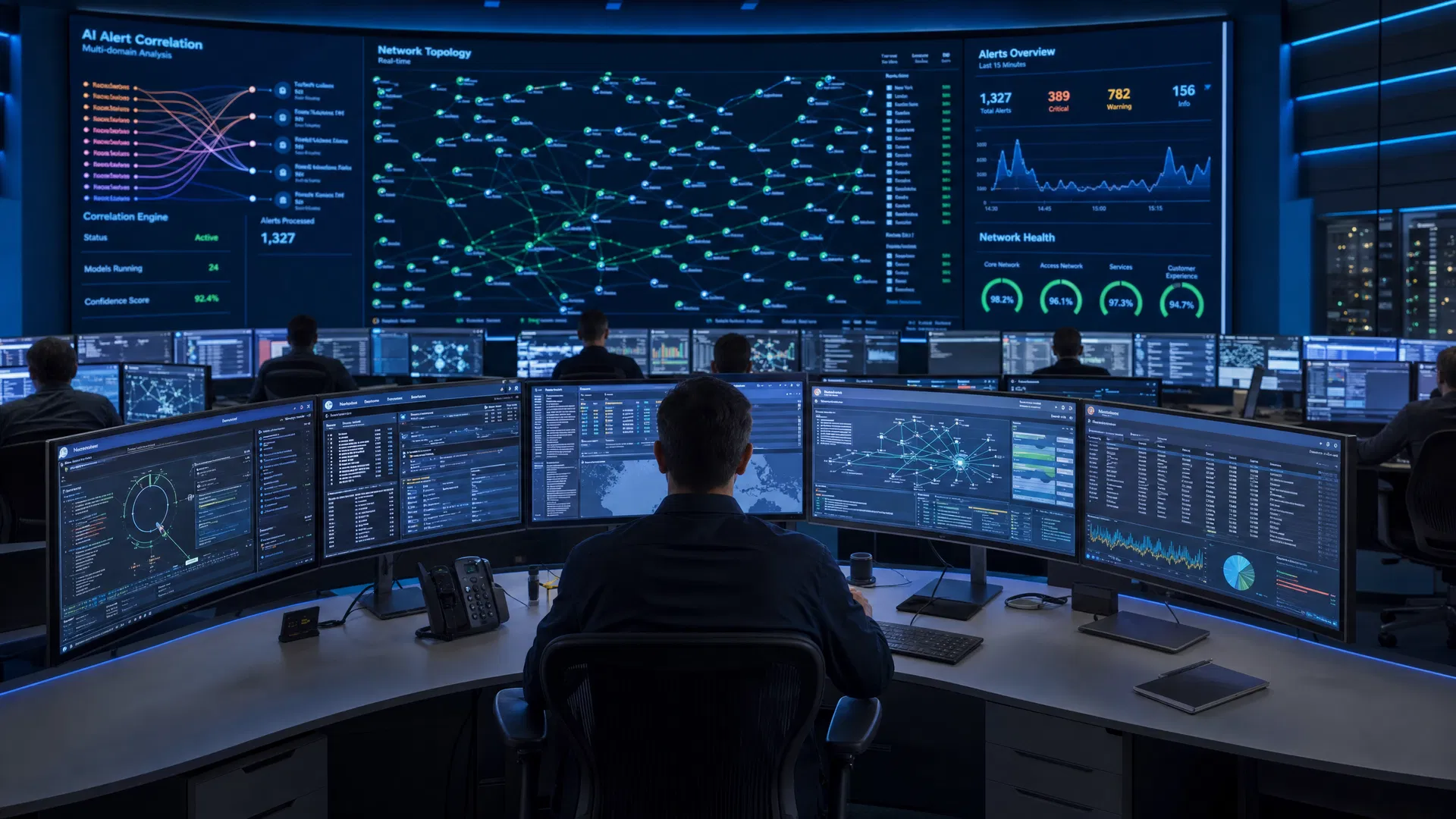
Telecommunications
Telecom operators have invested heavily in network infrastructure. The returns on that investment are increasingly determined not by the infrastructure itself but by the intelligence layer running on top of it.
8 min readStrategy
Governments and enterprises across the Gulf are committing significant capital to AI transformation. The organisations seeing results are those that treated AI as a strategic management question before treating it as a technology question.
Risk & security
The enterprise security function is evolving from a compliance obligation into a source of operational intelligence. The transition requires more than new technology — it requires a different conception of what security is for.
Where this connects
A practice rarely comes alone. Each one below is where clients usually end up after this one, or where they start before getting to it.
Industries served
A short conversation about your environment and the operational intelligence decision you want to improve. One hour, no cost, no commitment.
What happens next
Or reach us directly


 Siemens MindSphere
 ABB Ability
 Azure IoT Edge
 AWS IoT Greengrass
 Cisco IOx
 HiveMQ
 Databricks
 Snowflake
 Python and PyTorch