
AI strategy in high-growth markets: lessons from the Gulf
April 28, 202610 min readBy Ali Aarish

The organisations leading transformation across Gulf markets — in energy, infrastructure, logistics, government, and financial services — are not debating whether to adopt AI. They are working out how to deploy AI at the scale and in the operational environments their ambitions require. That is a fundamentally different question, and it demands a fundamentally different answer from advisers and technology providers alike.
The most common failure mode among Gulf enterprises pursuing AI is the conflation of AI investment with AI capability. Deploying AI to satisfy programme requirements — without integrating it into the operational fabric of the organisation — produces showcase installations rather than genuine transformation. The result is capital expenditure without proportionate return, and a widening gap between stated ambition and operational reality.
The limitations of generic AI platforms become apparent quickly when they encounter real operational environments. Industrial data, financial transaction data, and government service data each have characteristics that general-purpose machine learning platforms are not designed for — domain-specific failure modes, integration with systems that cannot be disrupted, and regulatory requirements that demand explainability at every decision point. What works for recommendation or document classification does not translate directly to the high-stakes decisions these sectors need to improve.
The organisations that will define technology leadership in high-growth Gulf markets are those that understand both dimensions of the challenge: the scale of the transformation ambition, and the operational reality of the environments where that transformation must happen. Meeting these ambitions is not a procurement exercise — it is a management and delivery challenge of genuine complexity. The firms that build the capability to meet it will hold a durable competitive position.

Most enterprise AI programmes fail not because of the technology but because of how organisations approach them. The firms capturing lasting value share three disciplines that have nothing to do with model performance.

Telecom operators have invested heavily in network infrastructure. The returns on that investment are increasingly determined not by the infrastructure itself but by the intelligence layer running on top of it.

The enterprise security function is evolving from a compliance obligation into a source of operational intelligence. The transition requires more than new technology — it requires a different conception of what security is for.

Most organisations approach data architecture as an IT infrastructure question. The firms that extract the most business value from their data treat it as a strategic design question — one that belongs in the boardroom, not just the server room.

Financial institutions have been among the earliest and most enthusiastic adopters of AI. They have also produced some of the clearest illustrations of where AI programmes go wrong and what it takes to make them last.

Retailers collect more customer data than ever. Most of it sits in systems that don't talk to each other, analysed by teams that don't talk to merchants. The result is insight that arrives too late to matter.

AI readiness is not a technology question. It is a diagnostic across strategy, data, governance, talent, and operating model. Most organisations that think they are ready are not — and the signals are detectable before any money is spent.

Healthcare AI projects fail at a rate that should give every executive pause. The failure mode is rarely the algorithm — it is the operating environment the algorithm is dropped into without adequate preparation.

Route optimisation is frequently the first AI application logistics companies pursue. It is also the one most likely to deliver disappointing results — not because the technology doesn't work, but because the problem definition was wrong from the start.

The energy transition story is usually told as a generation story. The harder problem — and the one operators are investing the most in — is grid flexibility: matching variable supply and variable demand in real time across infrastructure built for neither.

Smart city pilot projects are familiar. Smart city permanent operating capabilities are considerably rarer. The difference between cities that make the transition and those that do not comes down to a small number of decisions made at the start.

Government digital programmes report high levels of service digitisation. The metric that matters — end-to-end completion rate — tells a different story. Most programmes have not yet made the measurement straightforward enough to be honest about it.

Real-time quality inspection technology has matured. The constraint on returns is no longer the model — it is the operating environment, the taxonomy, and the discipline to keep the system trustworthy through normal manufacturing variation.

Claims automation has a sound business case. It also has a set of trade-offs that are routinely underweighted in the evaluation process. A candid note for insurance executives assessing the move.

ESG reporting is moving from voluntary disclosure to assurance-grade obligation. Most enterprises are not ready, and the reason is rarely policy — it is the data layer underneath the report.
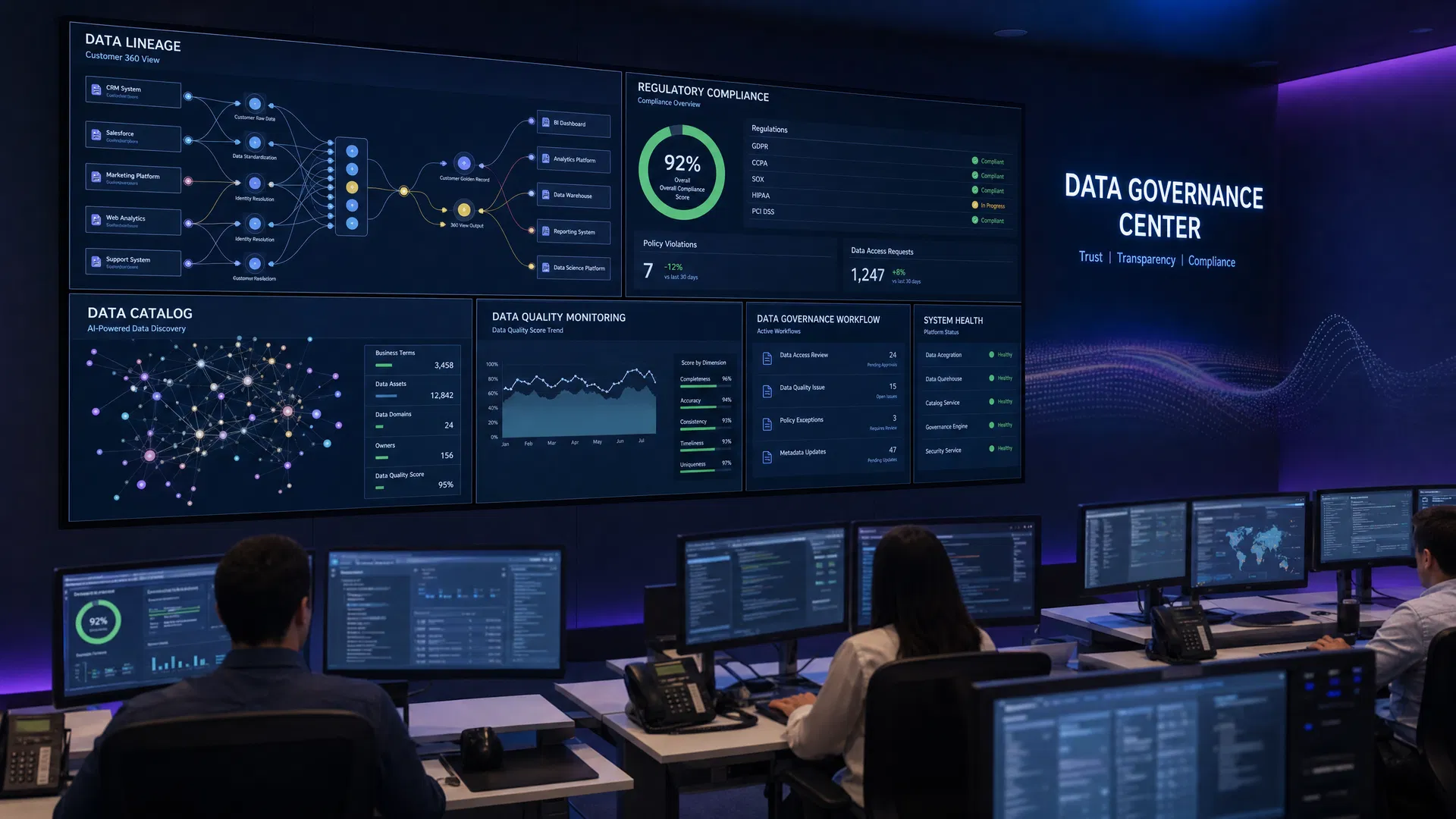
Data governance was a back-office concern until AI made every production model a regulated artefact. The four decisions that determine whether an enterprise's governance approach holds up under supervisory scrutiny.

MLOps reference architectures are well documented. None of them describe what changes when the model is regulated and every promotion to production needs documented approval from a named accountable person.

Boards have moved past asking whether the enterprise should use AI. The question is now what the enterprise is exposed to by using it, and whether management can demonstrate the answer is known and managed.

AI in the security operations centre tends to fall into one of two patterns: the kind that converts existing alert noise into actionable signal, and the kind that adds more noise. The distinction is detectable before you sign the contract.