

Enterprise Data Architecture
Modern data lakehouse and warehouse architectures designed for operational scale, AI readiness, and long-term governance.
01 / 05Why this practice exists
AI programmes are only as good as the data foundations underneath them. Our data and AI systems practice works with organisations to assess their current data architecture, identify the gaps that limit analytical and AI capability, and design and build the platforms — data mesh, lakehouse, streaming pipelines — that enable the use cases that matter. We also work on data governance: the policies, ownership models, and quality standards that make data usable, trustworthy, and compliant across the enterprise.
The starting point
The numbers that shape this practice. Market figures come from published research; delivery figures come from Techbanq engagements.
of executives cite data quality as the AI barrier
of leaders plan to increase data investment
ROI gap between data leaders and laggards
more revenue growth at data-driven enterprises
How it shows up day to day
The same KPI lands at the executive committee with three different numbers from three different teams. The hour before the meeting is spent reconciling, not deciding, and the credibility of the underlying data is slipping.
Every AI use case discovers the same problem at sprint two — the data is fragmented, ungoverned, and incomplete. The modelling team waits while the integration team starts from zero.
Saudi PDPL, UAE PDPL, and the regional data-localisation regimes require documented lineage, classification, and consent. Most data estates cannot produce that documentation today.
A Snowflake, BigQuery, or Databricks bill has arrived without the use cases to justify it. The data platform is in place; the value layer is not yet wired in.
Why now
Every AI ambition — from copilots to autonomous operations — eventually collides with the same constraint: data that is fragmented, ungoverned, and unreliable as a system of record. The boards that have funded AI pilots are now asking why the next release date keeps slipping, and the answer is almost always upstream of the model.
At the same time, the regulatory environment has tightened. Saudi PDPL, SAMA reporting cadences, and NCA classification rules now apply directly to the data plane, not just to the systems that read from it. A modern data platform has to be both AI-ready and audit-ready, and the architectural decisions that satisfy one increasingly determine whether the other is possible.
Retrieval-augmented systems, agentic workflows, and copilot-class products demand vector-indexed, lineage-traced, governed data. The lakehouse is now the substrate, not the destination.
Saudi PDPL data-subject rights, SAMA prudential reporting, and NCA data-classification rules apply to the data platform itself. Governance is no longer a layer above — it is a property of the architecture.
Batch-overnight is no longer competitive for fraud, network operations, demand response, or customer experience. Streaming architectures (Kafka, Flink, change-data-capture) are now the default.
The data-mesh and data-product model has moved from theory to operating standard at scale enterprises. Without product ownership, the platform reverts to a swamp within two release cycles.
How we help
Each card below is a piece of work with an owner, a delivery team, and outputs the sponsor can see. If one of them is what you need right now, the rest can wait.
How we work
Every phase has a named owner, named deliverables, an estimated timeline, and a decision at the end.
We assess the current data architecture, catalogue the sources and their quality, and identify the gaps that limit analytical and AI capability. The output shows where fragmentation is costing the business and what an AI-ready foundation requires.
What you get
A data foundation that AI and analytics programmes can build on without first fixing the data
A single, reconciled set of operational KPIs the executive committee trusts
Data governance documented to PDPL, SAMA, and internal audit expectations
Reduced time from business question to trustworthy analytical answer
Find out how quickly these outcomes can land in your operation.
Schedule a consultationSector fit
Every sector has its own pressure points. Pick yours to see the complexity we work inside and the use case we deploy.
Operational complexity
SAMA and SOCPA reporting against transaction, customer, and risk data spread across core banking and adjacent systems.
What we deploy
Risk and regulatory data foundation with a single customer view, a single product view, and the lineage SAMA will accept.
Sector · Banking and financial services
Inside this practice
Four deep dives inside this practice. Some clients start with just one; each has its own page, its own approach, and named deliverables.
White paper
2TB average daily data generated by a mid-size complex enterprise deployment
55% reduction in operational incident response time with real-time monitoring architecture
38% improvement in asset utilisation from data-driven intelligent scheduling
36 pages · 20 min read
Read the report2TB
average daily data generated by a mid-size complex enterprise deployment
Techbanq Research
Not marketing promises. These numbers have repeated across the engagements we have delivered on this practice.
Faster time to a trustworthy operational KPI once the domain data product is in place.
Lower data platform cost after the first FinOps review — driven by workload right-sizing and unused-dataset retirement.
Auditable lineage and classification aligned to Saudi PDPL, UAE PDPL, and the relevant cross-border regimes.
One reconciled set of executive KPIs across the operating company — not three versions of the same number.
Governance & assurance
Governance is engineered into the platform — lineage, access, retention, and consent traced from the source system to the model output.
Data-subject rights, consent capture, retention rules, and cross-border transfer controls aligned to Saudi PDPL and GDPR — automated through the platform, not enforced by policy alone.
Regulatory data feeds engineered to SAMA prudential, CMA capital-markets, and sector-specific reporting cadences with versioned, auditable transformations and named control owners.
Column-level lineage, NCA-aligned data classification, and attribute-based access control so every analytical asset has a defensible provenance and audience.
Data-quality contracts, freshness SLOs, and observability tooling that surface drift before it reaches the dashboard or the model — with the evidence trail an internal audit will accept.
Vector-index governance, RAG-source attribution, and training-data lineage so the AI platform built on top of the data plane is itself auditable to ISO 42001.
Technology ecosystem
We deliver on the platforms that actually run the enterprise, not a stack locked to one vendor. Selection follows your operating environment, not a reseller agreement.
24 tools across 4 categories
Lakehouse and warehouse
Streaming and integration
BI and visualisation
Frequently asked questions
Detailed answers on how this practice works in a GCC enterprise environment.
Financial services
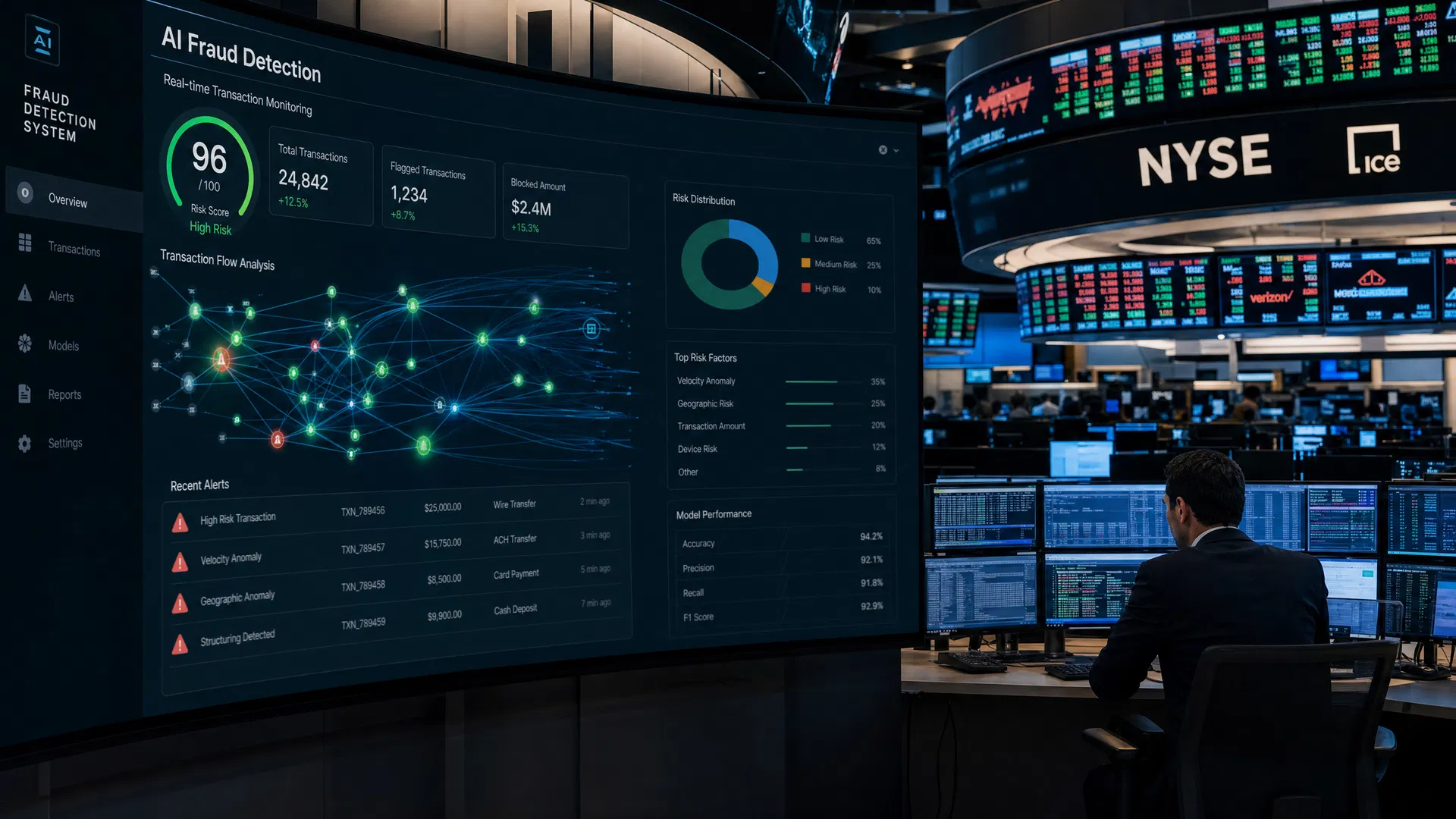
Financial institutions have been among the earliest and most enthusiastic adopters of AI. They have also produced some of the clearest illustrations of where AI programmes go wrong and what it takes to make them last.
7 min readRetail & consumer
Retailers collect more customer data than ever. Most of it sits in systems that don't talk to each other, analysed by teams that don't talk to merchants. The result is insight that arrives too late to matter.
AI strategy
AI readiness is not a technology question. It is a diagnostic across strategy, data, governance, talent, and operating model. Most organisations that think they are ready are not — and the signals are detectable before any money is spent.
Where this connects
A practice rarely comes alone. Each one below is where clients usually end up after this one, or where they start before getting to it.
A short conversation about your environment and the data & ai systems decision you want to improve. One hour, no cost, no commitment.
What happens next
Or reach us directly


 Snowflake
 Databricks
 Apache Iceberg
 Google BigQuery
 Amazon Redshift
 Azure Synapse
 Apache Kafka
 Apache Flink
 dbt
 Tableau
 Microsoft Power BI
 Looker
 Metabase